Thursday, March 7, 2019

Somec Multistrade Custom Gravel with Lauf Fork

Also realizing that I hadn't yet posted my latest gravel bike here. It arrived last Fall and I didn't get too many rides in before all this winter!

Custom alloy Somec Multistrade with Campy Super Record EPS, Lauf fork, Leonardi Racing seatpost and Speedplay SYZR pedals. More parts made by friends!

Horses - This stem was made to go with my Colnago C60 (due to Colnago's connection with Ferrari) that was sold to make room for this bike. Somec borrowed their hometown's (Lugo di Romagna) symbol of Enzo's Cavallino Rampante and reverted it back to having the tail pointing down. Ferrari himself was granted permission to use the horse from the family of famed Italian WWI pilot Francesco Baracca (also of Lugo). I had the pleasure to see his museum with the Gallegati family (of Somec fame) back in 2016!

Along with the Tommasini Fire gravel bike, I have three sets of wheels to change the character of this bike. Fat 650B's, light 700c gravel and 700c tubeless road wheels. The choices that disc brakes give us! I just came across some even fatter 650's with tread that I may have to try out, seeing how the Somec has plenty more space.


Old Bike Article Translations #3: Bianchi Caurus. The Renewed Proto.

Proving one of three points yet again:

  1. My translation of technical Italian is lacking
  2. Romance languages are terrible for technical descriptions, often scribbling a series of random 5-syllable words to describe something like "stiff"
  3. How much detail can you really give about a great steel frame?

Back in 2016 an internet friend started a great thread about this bike on BikeForums. I posted this translation of a 1990 Bicisport review back then (full scan of the article is here) and just realized it never made its way to the blog, so here we go...


Bianchi Caurus
The Proto is Reborn

All of the mountain and road bikes of the 1990 Bianchi catalog carry strange names and, in cycling terms, are already outdated. In reality the big Italian player wanted to renew itself even in its glossary, assigning to its offroad line Latin terms corresponding to the family of spiders, mainly because the spider can climb wherever it wants, like the friendly bicycle. The high end bikes were given names of winds, some picturesque and pleasant, since racing bikes are capable of higher speeds and are therefore similar to the idea of a strong wind.

Caurus, ie Cauro or Chorus, is a wind that blows from the west and occupies therefore the upper left part of the quadrant. In fact, in the Bianchi line, it corresponds instead to an elaboration, especially graphically, of the Proto model.

The Bianchi "Caurus" is the object of this test.

GRAPHICS

A bike utilizing tubing in a very peculiar form and painted in glossy black with neon green highlights could not necessarily be called ‘subtle’. This bike, is singled out from the group at close range but can be called out from a distance, even if being ridden by a lone rider.

And yet the Bianchi Caurus succeeds, in our opinion, by being flashy but not chaotic. The two colors form a sharp contrast and, combined with bad taste, could have resulted in definitely eye-catching results, but lacking in style. Instead, the bike has its own modern personality, that needed updating, especially as seen by a younger market. Looking at this model in its totality, you can appreciate its balance of the geometry that is made up of lines and angles, not of colors. Also noted, digging into the details, is the accuracy of the finishing, especially the head tube logo, the famous Bianchi eagle, which is pantographed and filled with neon green on the black tube. The component group ties itself nicely to the model with its finishing choices. The one exception, unbelievably, is the substitution of the water bottle cage that has an opaque grey finish which is totally removed from the complete package.

THE SPECS

The frame of the Bianchi Caurus Proto is contructed of Columbus Max, Tig welded without lugs, except for the seat tube junction and the fork crown. These are original Columbus items as well due to the understandable shaping necessary. These are very particular tubes ovalized in different directions on the same draw, studied for its resistance to various stresses, that could not fit to any commercially available lug.

The fact is that a structure of this kind corresponds theoretically to a concept of high functional rigidity, understandable even to the naked eye, with the implicit promise not to waste energy with unwanted flex even a portion of the energy applied to the pedals. The fork blades for example are very flattened in order to assure a relative stiffness front to back and a relative give laterally, necessary to keep your line when taking curves and leaning over at speed. The seat and down tubes meet the bottom bracket shell with larger diameters oriented to counteract pedaling forces.

This frame measures 52 x 53.5 cm from center to center. It is 27.1 cm high at the bottom bracket and has a very tight rear triangle, barely 39.5 cm, with a wheelbase of 97.5 cm. Particularly balanced is the rake of 14 cm and trail of 5 cm.

Frame mounts are all welded, with just one water bottle mount located on the down tube. Cable routing for the rear brake is inside the top tube, while the cable for the rear derailleur is inside the chainstay that is bare from any chain protection. Seeing as there is no chrome, it would be a good idea to apply an adhesive chain protector (transparent) even if our road tests didn’t result in any marks on the paint. The dropouts are semi-vertical, but the tips have no chrome on them.

The bike is assembled with Campagnolo’s Record group, with Delta brakes and chainrings of 41/53. Selle Italia Turbo saddle. 3t Super Competizione 42 cm handlebar and 3t 84 100 mm stem. Regina America freewheel, with lightweight alloy cogs of 13-14-15-17-19-21-23 teeth. The chain is a Sedis Sport with chamfered internal plates. Wheels are made up of Campagnolo Sigma "Pavé Hardox" rims of 32 holes, laced three-cross with 2 mm Alpina stainless spokes and wearing Vittoria Corsa CX Squadra Prof tubulars.

THE TEST

In the saddle of the Bianchi Caurus Proto we rediscovered a familiar taste. We’re referring to our 1989 test of the Proto model in its original Bianchi color, of which this bike represents a true copy. The winning feature of this racing bike is its geometry. This is a bike that allows you to immerse yourself in an efficient position both at a cruising speed and while at a frantic pace with accelerations and constant changes of pace. We didn’t note any appreciable flexing of the frame and were happy, as it relates to the stiffness this model is known for, to appreciate its comfort when the road was smooth. While climbing the Caurus certainly has a constant yield when climbing regularly and is ready to respond when attacking out of the saddle. The relatively tight rear triangle is an issue in twisty descents: it’s necessary to move your weight to the rear to face tight radiuses with security.

From a mechanical point of view, we had to adjust the bolts on both derailleurs, but this is normal. That said, we had to intervene on the rear brake pads in order to adjust the wheel guides, which were misaligned. On the other hand, upon flatting a tubular, we were forced to deal with an excellent job of gluing, which was perfectly even and applied while warm, as you need to do on a high end bike like the Bianchi Caurus, taking its place alongside racing models of the highest value.

Fulvio Lo Monaco

Data Sheet
Brand: Bianchi spa • Reparto Corsa • Cascine Battaglie, 5 • 24047 Treviglio •
Tel. 0363/41444
Model: Caurus Proto
Launch date: 1989 Milan Trade Show
Color: black/neon green, black/celeste Bianchi, black/pearl coral, green/pearl violet, fuchsia/violet
Available sizes: from 49 to 63 cm (cc) or custom
List price: Lire 3.230.000

Technical Details
Tubing: Columbus Max in nivacrom steel
Conjunctions: seat tube juncture and fork crown Columbus, the others are made with Tig welding, joined head to head
Group: Campagnolo Record with Delta brakes
Saddle: Selle Italia Turbo
Handlebar: 3t Super Competizione, stem 3t 84
Freewheel/Cassette: Regina America superleggera
Chain: Sedis Sport
Rims: Campagnolo Sigma Pavé Hardox
Spokes: Alpina
Tires: Vittoria Corsa Cx Squadre Prof tubulars

BS Ratings:
The Bianchi Caurus represents an esthetic elaboration of the Proto model. It is a proven and special high-performance bicycle.

ESTHETICS AND FINISH 8
The welding is workmanlike. The model is elegant in its lines and volumes. New are the colors and approach.

POSITION IN THE SADDLE 9
The proven geometry of the Caurus results in a perfect fit and does not need those annoying adjustments.

CLIMBING 9
Very balanced in power transfer, making it particularly efficient on medium climbs.

DESCENDING STABILITY 8
You must move your body weight back to lighten the front end. In doing so, you won’t notice any loss of traction.

RESPONSIVENESS 9
In out of the saddle attacks you will particularly appreciate the short rear triangle and the relative rigidity of this type of tubing.

VIBRATIONS 7
The bike shows its best on a smooth road. The road bumps are not absorbed by the frame.

MECHANICAL 8
Small problem in adjusting the brake shoes and in setting up the rear derailleur. Great were the true wheels and the gluing of the tubulars in the heat.

Note that the voting expresses our vote relative to the Technical Details of the tested product.

Photo Captions:

The seat tube junction is the only lug utilized in the Bianchi Caurus Proto, whose tubes are Tig welded. Above, the Caurus model in its original colorway.

In the photos on this page you can see some of the important details of the Caurus: the bottom bracket shell, the heat tube junction and the internally routed rear derailleur cable.

A view of the handlebar, with its round curve, from the rider’s point of view. Below, the “motor” of the Caurus. In the upper right, the elegant line of the fork with its teardrop shaped dropouts

Old Bike Article Translations #2: Bianchi Minimax Record

Proving one of three points yet again:

  1. My translation of technical Italian is lacking
  2. Romance languages are terrible for technical descriptions, often scribbling a series of random 5-syllable words to describe something like "stiff"
  3. How much detail can you really give about a great steel frame?
This article is from La Bicicletta, January 1993. My translation below the images.


Bianchi Minimax Record

di Bebo Fiacciavento / foto M. Venditi

The new Bianchi Reparto Corse is just one year old. The new structure focused on high end road and mountain bikes is the birthplace of this special model.

Bianchi, after a brief pause in its direct sponsorship of pro teams, has resumed hostilities as it restarts production of racing frames. In preparation of its return to pro racing, Bianchi has formed a new company, the Bianchi Reparto Corse Srl, with the sole focus of developing and producing the line of bikes destined to professionals and those who ride at a high level. And it does so for itself, seeing how it was aboard a celeste Bianchi that Gianni Bugno won his second world championship.

The continuity of the traditional characteristics of each piece made by the Reparto Corse are the most up to date in terms of technology, research and testing. The actual realization of the frame is instead trusted to the human element, where the experience and sensibility of an artisan cannot be substituted by a computer. It was therefore interesting - we can't forget that some of the greatest names of the sports most notably Fausto Coppi, are tied to this brand - that we accepted the task of carrying out the tests on a unique high end model that bears the logo of the crowned eagle.

Starting from the top: the color is the traditional celeste, updated with a changing pearl coat, interrupted only with simple identifying logos (starting this year even these will be painted) and chromed rear triangle and fork. They are laid out in successive layers: background primer, paint/color, pearl coat, final clear coat; each coat is baked at 140 degrees. The result is aesthetically pleasing and resistant to hits, scratches and degenerative processes, atmospherically and otherwise. The frame, before starting in the paint department, undergoes an anti-oxidation process and immersed in a chroming bath, this last piece to give even further protection to the tubing in case of the paint being removed. The frame is made, as we mentioned, with butted Columbus Minimax tubing in Nivacrom, a steel of the latest generation that has, among others, the merit of combining extreme mechanical characteristics with a high capacity to withstand the temperatures used during the welding process; in our case TIG welding in a controlled environment to avoid changes in temperature. The tubes are mitered and joined head to head and a close visual and tactile examination prove this to be very well executed. The absence of abnormalities reassures us of the continuity and homogeneity of the tubing sections. These, in particular the top and down tubes, have an elliptic section oriented in different manners. The respective planes thus have a corresponding contrasting incidence which increases the cofficient of reduction of the flex, forced oscillation and dispersion of the lines of force that propagate along the main tubes. The configuration of the down tube increases the transversal rigidity, favoring sprinting and stability.

The chain stays are have no bridge and together with its corresponding seat stays contribute to form a smaller rear triangle that is compact and rigid. The benefits of this are felt while climbing and in changes of pace, where frequent accelerations are supported by the static rear triangle. A rapid rear wheel removal is assured instead by the forged rear dropouts brazed with a vertical exit with adjusting screws for making micro adjustments to the wheel's position. The fork blades are made from Columbus EL tubing TIG welded to a reinforced steer tube and brazed dropouts. It has a uncrown profile, used more and more on various models of road bikes (the Reparto Corse was one of the first to take this path), where the length of the blades remain whole to better absorb the hits and vibrations. The time tested measurements of trail and rake assure sweet steering.

Here are the essential measurements of our Minimax: 57cm high x 56.5cm long, center to center (in reality Bianchi calls this a 59 due to the entire length of the seat tube; we prefer to adopt the other measure for consistency). The rear triangle is 40cm while the front center is 60, making a wheelbase of 99. The fork rake is 39mm; lastly the bottom bracket sits 27.5cm high. The seat tube angle is 72.5 degrees while the steerer is 72.  We find ourselves in front of a frame that as a whole is very well proportioned in its various sections, solid due to the compactness of its triangles; the impression however is one of lightweight and agility. It was without a doubt intended for racing, and the sum of the rear triangle and the angles underline the intent of the frame builder.

There is little to say about the gruppo: Campagnolo Record speaks for itself (the Reparto Corse foresees assembly with other groups from Campagnolo and Shimano); a thank-you anyway to the our Vicenza friends for the efficiency of the Ergopower system.

TECHNICAL CHART

Producer and Distributor: Bianchi Reparto Corse Srl, 24047 Treviglio (BG), Via delle Battaglie 5
Price: L4,500,000
Available Measures: cm 49-50-51-52-53-54-55-56-57-58-59-60-61-62-63 center/end
Measure Tested: 59cm
Colors: New Bianchi Celeste pearl, Ferrari red, Metallic red, White pearl
Weight Total: 10.250 kg
  Front Wheel: 1.385 kg
  Rear Wheel: 1.950 kg
FRAME:
Tubing: Columbus Minimax
  Seat Tube: 570mm c/c
  Top Tube: 565mm c/c
  Seat Tube Angle: 72.5 degrees
  Head Tube Angle: 72 degrees
  Rear Triangle: 400mm
  Front Center: 600mm
  Wheelbase: 990mm
  Bottom Bracket Height: 275mm
  Fork: Columbus EL
  Rake: 39mm
TRANSMISSION:
  Shift Levers: Campagnolo Record Ergopower
  Front Derailleur: Campagnolo Record
  Rear Derailleur: Campagnolo Record
  Chain: Campagnolo Rohloff
  Crankset: Campagnolo Record, 39-53
  Crankarms: 170mm
  Bottom Bracket: Campagnolo Record
  Cassette: Campagnolo 8v, 12-23
WHEELS:
  Hubs: Campagnolo Record, 32 hole
  Spokes: Aci stainless, 2mm
  Crossing: 3x
  Rims: FIR Tour 192
  Tires: Michelin Hi Lite Supercomp HD
OTHER COMPONENTS:
  Brakes: Campagnolo Delta
  Pedals: Campagnolo Record QR
  Headset: Campagnolo Record
  Seatpost: Campagnolo Record
  Saddle: Selle Italia Flite
  Stem: 3T AR 84, 130mm
  Handlebar: 3T Forma SL
  Accessories: water bottle, cage

Wednesday, March 6, 2019

1993 Bianchi Ads

Still vintage-ing over here. A bit of a wreck this winter after weeks of below-zero weather after a warm spell in January. Picked up a Reparto Corse recently so of course I ran back to the scanner with my 1993 issues of La Bicicletta. I've been brushing up on my 90's Bianchi info lately, so I'll probably post a translated review soon...

I believe the first two were either remnants of the 1992 campaign or they just changed style mid season.


Tuesday, December 4, 2018

3 Out, 4 In This Year

I promised not to n+1 (or s-1) too hard this year, but I failed. Out went the Colnago C60 - I got such a great deal on it that I actually made money on selling the frame. The Campy Record 11v EPS group stayed for the next project (more on that later). Such an amazing frame, why would I sell it? Well, I have another super light carbon, and I don't really ride that bike either! I'm never going to race (and crash) a frame that nice, plus they just came out with the C64, so...


Out went the Vianelli, to Australia of all places! There is a box dimension limit there, so shipping this was quite the experience. I had to split it into 2 shipments and customize the boxes to get them to fit!


And out went the Somec MS! I love the MS, but not to fear... there was a plan.


The main reason for the Leader MS sale was that an internet friend of mine from Russia, Alex, had another MS in my size and too small for him. A deal was struck and the long wait ensued. Evidently this frame was in Holland with a friend. Once Alex had it, he wasn't happy about the fork's chrome condition. What to do... the main reason I wanted this frame was that it was painted by the master, Mario Martini. It's what I really needed to have. Alex is a big fan as well, and he found the solution - chrome paint! It was the only way to get it back to looking near original while preserving the Martini details on the fork. Had I not written it here, nobody would ever notice!

I'm building it up with my new sweet spot - 10v downtube indexing shifters, Delta brakes and SGR pedals. Alloy 10v Campy! I have new decals and some neon housing on the way in both yellow and pink... this frame won't be subtle... just like the late 80's!


Speaking of Somec, the previously mentioned EPS parts will go on this new custom Somec Multistrade alloy gravel frame. The Lauf fork has been waiting in the garage for almost a year now, but will soon hit the road... and they're all gravel around here, so it's so appropriate!


I'm waiting on a few parts to finish it, but it may hit the "road" this weekend already! Gold ti bolts will be added over the winter, to match a gold KMC chain and a few other bits. Will also get a Leonardi seatpost, and there's one more little surprise that came from the C60's loose Ferrari connections/history.

So that makes 2 of 4. What else did I get on the plus side this year? Oh yeah, the Wolhauser and the alloy Colnago. N+1 is great when it is profitable or pays for itself over the long run! I guess I need some more photos...

Saturday, September 22, 2018

Colnago Master Ibex

I've been searching for a Tommasini Monte Amiata to hang my Record OR group on for a number of years. One failed attempt with a Yo! Eddy that was too big got me to rethink my options. While any Columbus-tubed Italian frame could work, to really have something special, you need to start with a special frame.

I've disliked, or rather been non-plussed with, Colnago's 80's and 90's colors for quite some time. Most likely I was jaded by the silly top tube rider or their odd fades and color combos. Whatever they got wrong on their classic road bikes, however, they got totally right on their mtb offerings.

The Master Ibex is now something that I'm going down the rabbit whole with. They can be had for good prices (the latest Monte Amiata frame is listed for $1700) if you know where to look, and come in a variety of tubing configurations (toss in a Gilco tube somewhere in the main triangle or even find an alloy version). So long as it's post U-brake (so, 1988 and on), I think I have a winner. I mean, just look at those gaudy colors!

I've read that the Master mtb frames are heavy as can be. No worry, so was the Record OR group! Also, scroll down far enough and you'll see the shoes that MUST be worn with it!


Friday, September 14, 2018

99 YEARS OF FAUSTO

99 years ago today, in a tiny village called Castellania above Novi Ligure, Fausto Coppi, the second Campionissimo, was born (the first being my hero, Girardengo, born just down the hill in Novi some 26 years earlier).

I was lucky enough to make a pilgrimage there in 2012. You begin to sense the history on the long road up the hill towards the town in the middle of (or on top of) nowhere. Around twisty bends, 100-year-old buildings are covered in mega posters of their champion.

I was able to talk my way into his childhood home, normally a museum and closed for most of the year and certainly on a January evening. A modest donation to the caretaker and the guided tour was on by a cousin of the great Coppi! Honestly, I think everyone in town claims to be a close relative. Why not?

The great Italian sports writer (and much more than that) Gianni Brera described Fausto Coppi:

“The bicycle is his the other half. He forgets about his looks, with his breastbone that could be stolen from a chicken, his short neck, his shoulders practically attached to his face, and his two feet that look like seal fins. The bike becomes a part of himself and his lopsided bones.”

Not what you would expect from someone who would become the most important sporting icon in Italy and the cultural symbol of a postwar nation trying to enter the modern age. He seemed fragile, but unbeatable on a bike. The kind of thing that every scrawny kid imagines when turning his pedals in anger...


Fausto and Serse's final resting place.


Fausto's childhood bedroom.


Serse's room.

Local shops still post his photo in the window.

Guide to monuments around Italy dedicated to Coppi.

To the left of il Gira, Coppi's wall at the Museo dei Campionissimi in Novi Ligure.

Friday, April 6, 2018

il Drali, Marnati and Fantini. Classic Italian Cycling Videos for your Friday Enjoyment

Masters of the trade. An artisan industry that today's market can't comprehend. True innovators of a process that may get lost in today's hyper technical world. Personalities. Legends.


This is the music we should all listen to in our shops! OK, either this, Vasco or RPI (Italian Prog)


il Drali's new partners reached out to me recently to discuss the US market and get my advice. Life is odd. Were I to stop in to il Drali's shop, I would sit and ask him about his father's work with Stucchi and listen for hours. I just put down another bullet point on my next l'Eroica trip planner!


Saturday, March 17, 2018

Pelizzoli, Ciöcc, Gion Italia and John the Star U.S.A.

I posted a reply in a Ciöcc thread over at Bike Forums and thought it should be on here as well. I typically go in the opposite direction but the content from a long phone call was too good to pass up. Here is the post in all it's glory...
Yes, that's my old video of Giovanni finally pronouncing and translating his nickname. I just got off the phone with him and after a LONG conversation, have a few more things I can offer... I hope ANY of it is useful or at the very least, interesting!

Gio was born in 1942 and at 25 built his first Ciöcc in 1967.

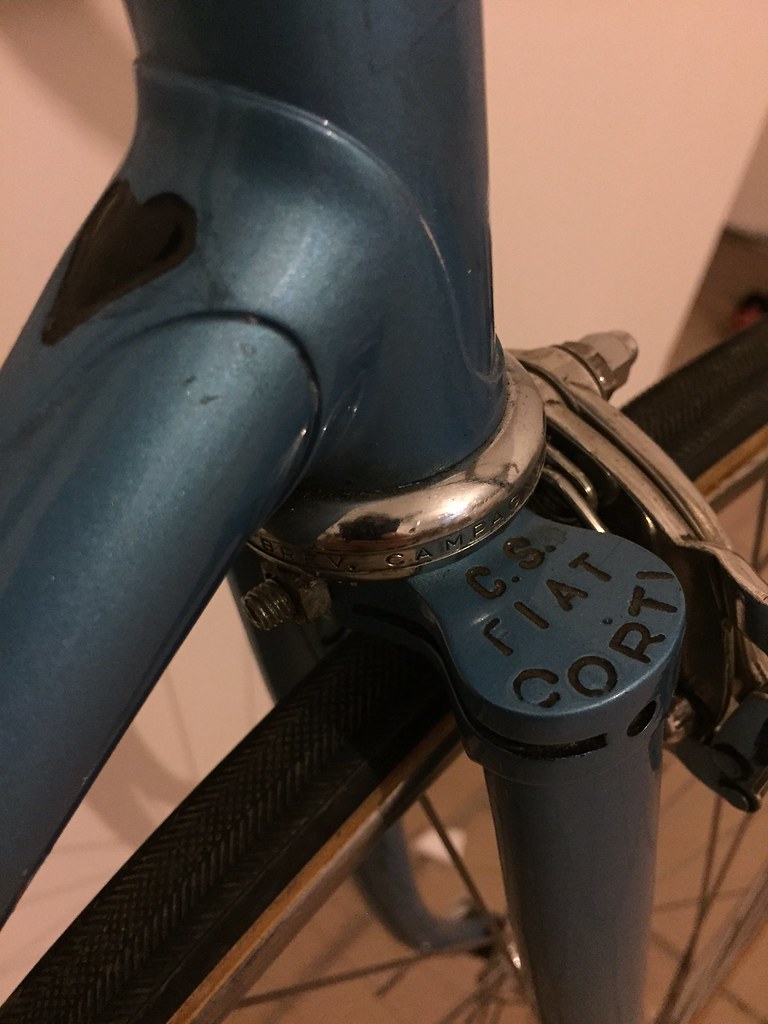
Here's an interesting one... my friend Claudio wasn't the first Corti to win aboard a Ciöcc. His brother Mario won the Vuelta de la Juventud Mexicana in 1971 for C.S. Fiat as a dilettante. Check out this image...


The Corti's, like Giovanni, were born in Curno. The first Ciöcc frames had just a "C" decoration, taken not from the nickname, but from the town Curno, which then merged with two other locales to form Curdomo, a model name used today under the brand Pelizzoli. Evidently, as Italian towns expanded there was plenty of name shuffling - reminds me of the direction Iowa schools systems are going!

Branding: The "C" with tail was inspired when Giovanni saw a Cimatti model with a similar tail. His new logo was met with consternation by the moto brand but was easily explained away in that his tail was curved while theirs was straight. When asked the exact timing of this, his only recollection is "Certainly after Claudio's win". Take that with a grain of salt though. I have seen mixed frames where the seat stay cap has no tail while the original decals do. Italian inventory planning of small raw materials was never precise!


Iper: Yes, literal translation is Hyper, supposedly "better" than Super. BUT - this name was applied to bikes sold in a local Curno/Bergamo bike shop owned by a close friend of Giovanni's! If you see this on a bike... I suggest buying it, as it represents a very narrow production range for a local marketer, hence rare and likely of top production - reputation locally was everything!


He names his Golden period of Ciöcc as 77-81 or 82... top of his head, he can't remember exactly when it was sold! He still retains the rights to the brands Gion Italia (Italian spelling of John) and John the Star U.S.A. I've been in his shop a number of times and have literally spent weekends there fishing around his piles of old junk frames - I've never seen evidence of a John the Star frame. It also deserves a good story, and there is one...

He got a phone call from a company in Milan threatening to file a suit against his use of U.S.A. Not sure the legal validity of such a case - we're talking Italy here. Giovanni replies with a question... 'well, what do you think U.S.A. means?!?' and the reply is obvious, followed by 'well, what do YOU think it means?' to which Giovanni replies his unassailable use of "Unione Saldatori Artigiani". The agent goes silent and the Union of Artisan Framebuilders never hears another word about the case.


The crew...

Hope this was interesting!